
See & Do
Upside-Down Garden
Precinct
Opening Hours
24 hours
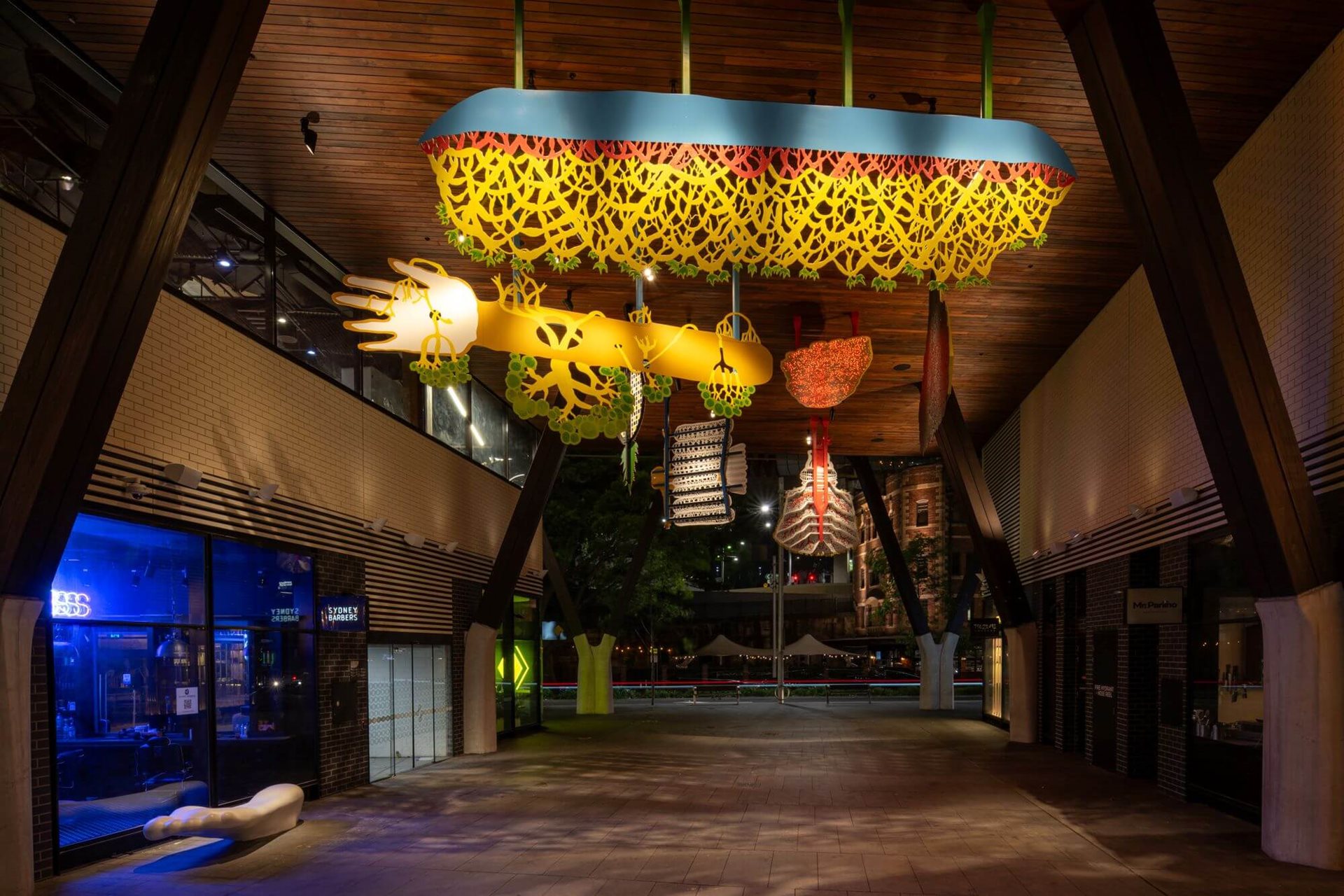
Created by Indonesian/Australian artist Jumaadi, Upside-Down Garden is a magical environment that evokes the transformation of life and objects from one state to another.
These hybrid forms in turn are inspired by myth and memory and drawn from the artist’s Indonesian heritage, his own personal motifs, traditional shadow puppetry and storytelling.Shadow play and soundscape are combined with sculptural forms drawn from real, fantastic and botanical worlds. As Jumaadi explains: “My work is about questioning the hierarchy between human and nature. This garden is an overlapping of time, creatures and history – the seen and unseen world, ghosts and memory. Populated with archetypes — hybrids of human and vegetable, fauna and man-made, current and previous, familiar and oddity, seen and unseen, ambiguous and blunt — to represent love, beauty, displacement, commonality and human experience.”
Each day and evening the artwork is activated with a soundscape and lighting program developed by Jumaadi with musician and composer Michael Toisuta, aligning with the astronomical clock and running for approximately 6 minutes:
- Dawn: Sunrise - Indicating sunrise in a coastal, mangrove area. I made recordings in a couple of national parks in using 2 pairs of stereo mics, and 2 shotgun mics. A lot of editing and cleaning up of the recordings was necessary to avoid human made noise pollutions. I added a few birds, native to East Coast Australia, while trying to maintain the natural rhythms of what was captured in the recordings.
- Midday: In Wind (Dalam Angin) - Focusing on natural elements wind and leaves, this piece grew to incorporate ‘Hitungan’, an older work based on Jumaadi’s memories of his family members counting fish seeds. The work reimagines the social life of the site of Upside Down Garden.
- Dusk: Sunset - Lots of similar elements to ‘Sunrise’ but with more emphasise on the tension between the controllable and the uncontrollable. Remaining faithful to the natural sound of the place, the composition uses field recordings over an hour in one site in Jervis Bay, edited without changing the sequence of natural events.
- Approaching midnight: The Nightlife - The sounds were recorded at the same location as ‘Sunset’. It follows the rise and fall of the sounds created by different insect groups. The sound sources are undeniable, yet remain unseen.
Commissioned for Mercantile Walk, Jumaadi's Upside-Down Garden is a multilayered intervention into public space, imbued with personal mythologies and cultural references. It holds fragments of time, creatures, history—both seen and unseen—memory and speculation. Upside-Down Garden evokes the natural world not as something separate or subordinate, but as a co-creator of human experience. This is not a neatly cultivated or controlled landscape. It is a reminder of our entanglement with nature, our dependence on imagination, and our need to be gently returned to the fertile ground of wonder.
The work finds correlation with the past and present of Barangaroo as a site of trade, commerce, social change and as a harbourside meeting place. The interplay between negative and positive shapes within the hanging forms creates a pattern sometimes dense and opaque like the roots of a tree or gauzy and translucent like cloth or the shape of leaves against the sky.
Artworks
- Wedding Gown - A tree with leaves – we are unsure whether it is native or introduced – but with a complex root and branch system. It grows inside a gigantic wedding gown. The wedding gown here is a symbol of European colonialism as this form of clothing has spread across many cultures. Beginning as a drawing it has now evolved to become a sculpture. The logic of making of this draws heavily on the process of paper cutting, stencil or making shadow puppets.
- Bird Man - This winged man is carrying the landscape within his body. Birdman is a human-bird hybrid. Hybridisation brings us the past, future or childhood dreams. Birdman is a creature who is free from the constraints of time, whose place in the garden is like that.
- Foot - This piece in the centre of the garden, its glowing shape is simple and organic. We recognise it, but it can also be foreign and ancient at the same time. It is inspired by ancient sculptures of footprints carved in stone. Those footprints make a historical place for us now
to visit and study. The lines of a footprint can form some kind of code that can reveal the origin, characteristics or identity of the owner. - Pineapple - Historically, this was an exotic fruit which was valued higher than the price of gold in Europe. Foreign, strange, thorny, ephemeral. The pineapple has a strong sculptural form. It is alien-looking, but its ugliness has wabi-sabi, its texture is beautiful.
- Woman’s Hair - This originated with my mother’s hair. Very long and entwined so it is hard to see the roots and ends, it creates a complex and beautiful pattern. There are hints about beauty and fertility, about immortality and fragility. But there are edges, and there is shadow. There is the in-between.
- Arm - The hand stretched out like a poem, like a river that extends a long bridge that unites two islands. It is a limb detached from its body overgrown by vines such as sweet potatoes or grapes.”
Boat Mountain - "A boat carrying mangroves. It should be an impossibility. This is a
reflection of the migration of flora and highlights the complexity between indigeneity and migration. - Foot Seat - As there is an armchair, there is a ‘foot seat’. A destination with an imagined mythological conceit – rubbing the toe for luck.
About the artist
Jumaadi was born Sidoarjo, East Java, Indonesia in 1973. He moved to Australia in 1996 and studied at the National Art School, majoring in painting. Working across mediums including painting, drawing, sculpture, installation and performance, he lives between Borogegal and Cammeraigal lands (Mosman) and Imogiri, Yogyakarta in Indonesia.Curated by Holly Williams and Glenn Barkley through The Curators’ Department
Project architect Caroline Comino
Soundscape Michael Toisuta
@TheRocks.Models.Tenant.TenantViewModel