
See & Do
Monuments for Fishes
Precinct
Opening Hours
24 hours
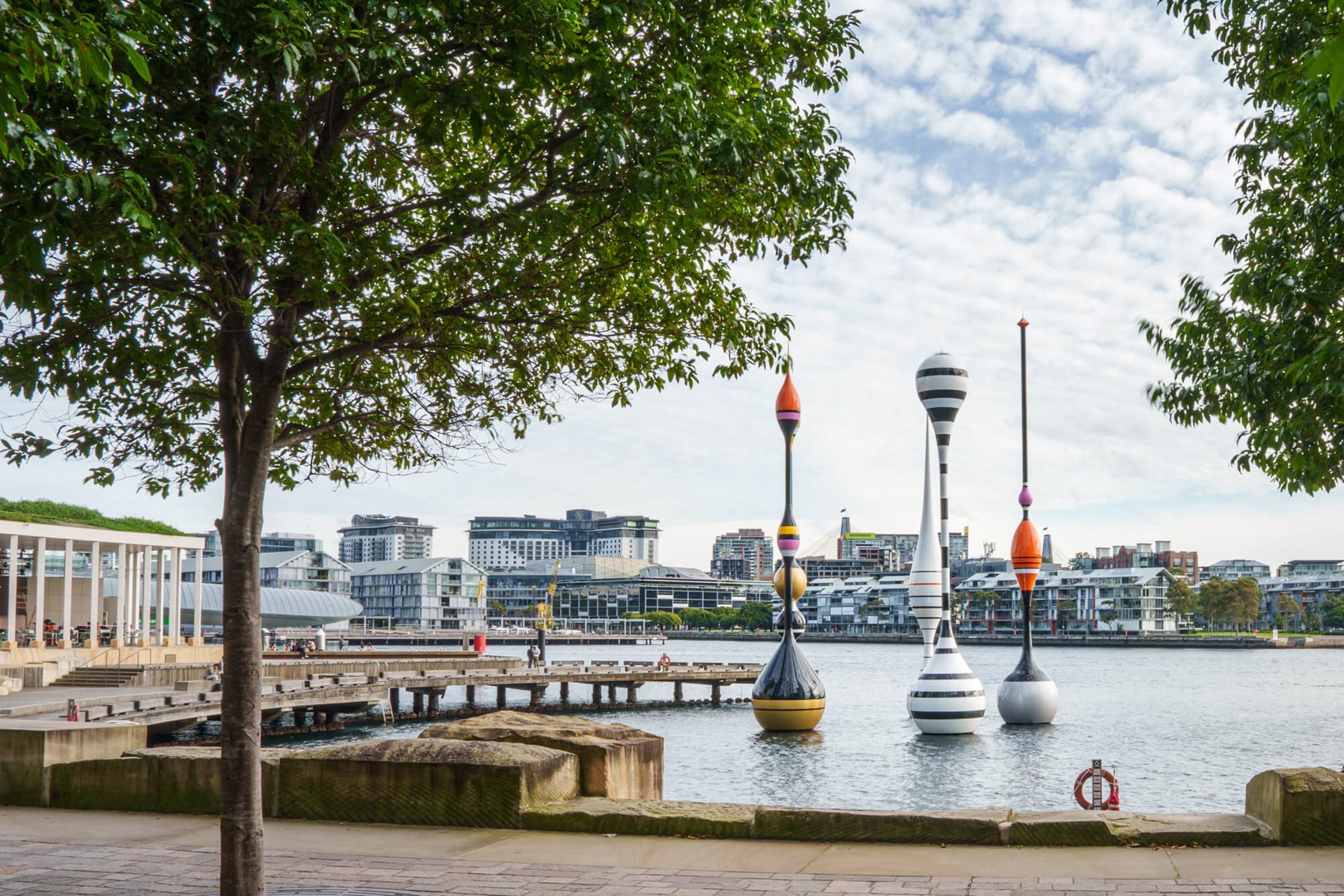
Through her majestic 'Monuments for Fishes', Mikala Dwyer responds to the rhythm of the sea, the vast ecology of sea creatures, and the history of fishing at Barangaroo.
Sydney-born artist Mikala Dwyer works across sculpture, installation, painting and performance. Monuments for Fishes is all of these, a collection of playful, mobile forms through which Dwyer channels her response to Watermans Cove and its history. It has echoes in the history of geometric painting and abstract sculpture and an optimistic, larger-than life presence that is quintessentially Sydney.Monument for Fishes was commissioned by Lendlease and can be seen from many vantage points, including East Balmain, Pyrmont and other harbour locations, as well as from the city.
Mikala Dwyer has exhibited widely in Australia and internationally and is known as a master of metamorphosis for her ability to transform ordinary objects and materials. Monuments for Fishes was inspired by something you can hold in your hand – tiny, lightweight fishing floats with coloured stripes that Dwyer had in her studio. She reimagined the floats as this gathering of grand, buoyant forms that pays homage to Barangaroo and the coastal fisherwomen at the Watermans Cove site from time immemorial.
Through a remarkable transformation in scale and orientation these forms become richly associative. Minarets and totems come to mind. Their curvaceous vertical shapes recall the human body but are also beyond human. A powerful sense of gravity connects Monuments for Fishes to our bodily experience and draws attention to the harbour’s depths, while its elegance and elevation inspire our imaginative projections.
Monuments for Fishes responds to Watermans Cove through continual movement, a material relationship to boats, buoys and fishing, and an underwater structure that provides a reef-like habitat for marine life. Whether glowing in the sun or lit from inside at night, dancing or offering a contemplative presence, it is a barometer of the harbour’s energy cycles.
As a lover of myth, Dwyer knows that with buoyancy there is also drowning. The depth and mysteries of the sea and make it a favourite symbol of the unconscious. Her five monuments tip the hat to Kenneth Slessor’s 1939 poem “Five Bells”, which Dwyer describes as ‘his meditation on memory and time and his friend Joe Lynch, who famously drowned in Sydney Harbour assisted by the weight of beer bottles in his pockets.’ For Dwyer, the poem is ‘deeply situated in the imaginary of Sydney Harbour and its people. With John Olsen’s painting Salute to Five Bells, 1973, around the bay at the Opera House, it builds a modern mythology of the harbour.’
It takes a community
Dwyer’s work is always about relationship – between objects, between the viewer, the work and its surroundings – and her decision to make a circle of five monuments emphasises the idea of communion. To her, ‘Five is the first of the single-digit numbers to connote a sense of the social and implies a more open and dynamic exchange than the lower numbers. The five forms represent the idea of community.’It took a community to produce the work that Dwyer imagined, ‘swaying with a magical stability, much like the balance required when fishing in a tiny boat’. She worked closely with numerous engineers and fabricators to make these towering forms. They range in height from 18.6 to 22.6 metres above the water-line – though one is a mere 20 centimetres across at its narrowest point – and weigh between 13.2 to 16.1 tonnes each.
The marine and mooring design followed that used for boats, sea buoys and other navigational markers, as the engineers aimed to make the monuments ‘float, move up and down with the tide, and sway laterally – with a languid frequency that matches the artist’s intention’. They stabilised the lightness of carbon fibre with steel cores and ballast in the monuments’ rolling bases, and protected the work against lightning strikes and the corrosive effects of saltwater on steel.
In collaboration with the artist, Event Engineering (lead engineer) worked with Innovations Composites at its facility in Nowra, NSW, to construct the monuments. They had worked on other public commissions for Dwyer and brought expertise in making all types of marine structures, from speed boats to super-maxi yachts. The final painted forms travelled in large sections to Sydney where they were assembled, prepared and towed by Sydney City Marine to Watermans Cove.
Collaborators & contractors
- Event Engineering
-
Innovations Composite
-
Browns Grafix
-
Shire Steel
-
Blackpond Marine (Marine Engineering)
-
Ellis Engineering (Composite Engineering)
-
Polaris Marine Constructions
-
Reneo Engineering
-
Steensen & Varming (Lighting Designer)
-
Cundall Electrical Engineering
-
Royal Haskoning (Peer Review)
-
CPP Wind Engineering Consultants
-
Akzo Nobel (Paint Specification)
Mikala Dwyer, Distinguished Professor, RMIT, Melbourne, would like to thank RMIT University School of Art for its support.
Mikala Dwyer is represented by Roslyn Oxley9 Gallery, Sydney; 1301SW, Melbourne; and Stark White, Auckland, New Zealand.
@TheRocks.Models.Tenant.TenantViewModel